
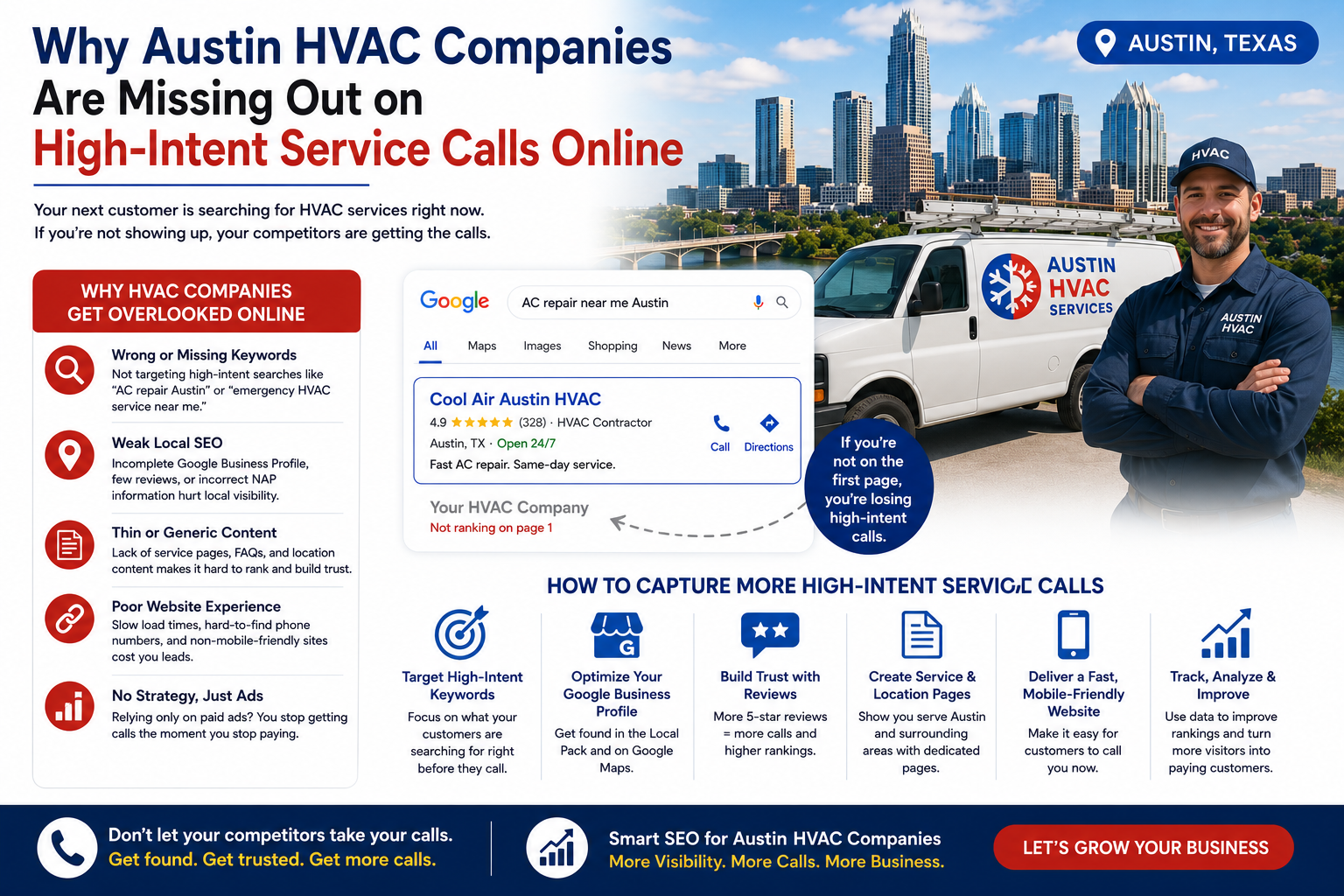
A homeowner’s air conditioner stops working during a Texas heat wave. What’s the first thing they do? They grab their phone and search for an HVAC company nearby.
The problem is that many Austin HVAC businesses never appear in those search results. Even companies with years of experience, excellent technicians, and strong customer reviews often struggle to generate consistent leads online. Meanwhile, competitors continue capturing service calls, maintenance requests, and installation projects.
If your HVAC company relies heavily on referrals, repeat customers, or paid advertising, you may be leaving a significant number of opportunities on the table.
The Austin HVAC Market Is More Competitive Than Ever
Austin continues to attract new residents, businesses, and real estate developments. As the city grows, so does the demand for heating and cooling services.
The challenge is that more HVAC companies are investing in digital marketing than ever before. Businesses that once depended solely on word-of-mouth are now competing for visibility on Google, Google Maps, and local search results.
When homeowners search for:
- AC repair in Austin
- Emergency HVAC services
- Air conditioning installation
- Furnace repair near me
- HVAC maintenance company
Google displays only a limited number of businesses at the top of the results.
Those positions generate the majority of clicks and calls.
Why Many HVAC Websites Fail to Generate Leads
A common misconception is that having a website automatically leads to more customers. Unfortunately, many HVAC websites suffer from issues that limit their visibility.
Some of the most common problems include:
- Generic service pages
- Slow page speed
- Weak local SEO signals
- Poor mobile experience
- Limited content
- Few customer reviews
- Incomplete Google Business Profiles
Even if your company offers excellent service, potential customers may never find you online if these issues exist.
The Cost of Relying Only on Paid Advertising
Many HVAC companies invest heavily in paid ads because they produce immediate visibility.While advertising can generate leads, costs continue to rise.
The challenge becomes clear during slower seasons. When ad budgets decrease, lead volume often drops as well.
SEO creates a different type of growth.
Instead of paying for every click, HVAC businesses can build long-term visibility that continues generating traffic and leads over time.
Many companies discover that combining SEO with paid advertising creates a stronger and more sustainable marketing strategy.
Google Maps Often Drives More Calls Than Websites
One area many HVAC businesses underestimate is Google Maps. When someone searches for a local service, Google frequently displays a map pack before traditional search results.
For emergency HVAC services, these map listings can generate a significant percentage of incoming calls. Improving local visibility often involves:
- Optimizing your Google Business Profile
- Collecting customer reviews
- Updating business information
- Adding service-specific content
- Publishing project photos
These signals help search engines understand your relevance to local searches.
Content Marketing Is Not Just for Large Companies
Many HVAC contractors assume blogs and content marketing are only useful for large brands.
The reality is different.
Homeowners regularly search for answers before contacting a contractor.
Questions such as:
- Why is my AC not cooling properly?
- How often should HVAC systems be serviced?
- What is the cost of replacing an air conditioner?
- Should I repair or replace my HVAC system?
Businesses that answer these questions can attract potential customers earlier in the decision-making process. This approach also helps establish trust before a homeowner picks up the phone.
A Quick Example
One Austin HVAC company focused almost entirely on referrals for years. Their business performed well during peak seasons, but lead volume became unpredictable.
After improving local SEO, optimizing service pages, and creating content around common homeowner questions, they began receiving more inquiries from organic search.
The biggest difference wasn’t just traffic. It was the quality of leads. The people contacting them were already searching for HVAC services and were often ready to schedule an appointment.
This is where many businesses unknowingly miss opportunities.
How AI Is Changing Local Search
Search behavior is evolving.
Consumers are asking more detailed questions and expecting immediate answers. Search engines are using artificial intelligence to better understand intent and deliver more relevant results.
This means HVAC companies need more than simple keyword optimization.
Successful SEO strategies now focus on:
- Topical authority
- Helpful content
- User experience
- Local relevance
- Technical website performance
Businesses that adapt to these changes often gain a competitive advantage over companies relying on outdated SEO tactics.
The Importance of Building Long-Term Visibility
Many HVAC companies focus only on immediate lead generation.
While that approach can work in the short term, long-term growth usually requires a stronger online foundation.
A comprehensive strategy often includes:
- Local SEO
- Technical SEO
- Content development
- Reputation management
- Google Business Profile optimization
- Internal linking
- Conversion-focused website improvements
These efforts help create a steady flow of qualified traffic throughout the year.
Final Thoughts
Austin’s HVAC industry continues to grow, but competition for online visibility is growing just as quickly. Businesses that fail to invest in SEO often find themselves relying more heavily on referrals and increasingly expensive advertising campaigns.
Companies that improve their local search presence, optimize their websites, and create helpful content are often better positioned to attract homeowners actively searching for HVAC services. If your company depends on local customers, this is worth paying attention to. The businesses winning online today are often the ones that started building their visibility months before their competitors realized the opportunity.
No responses yet